
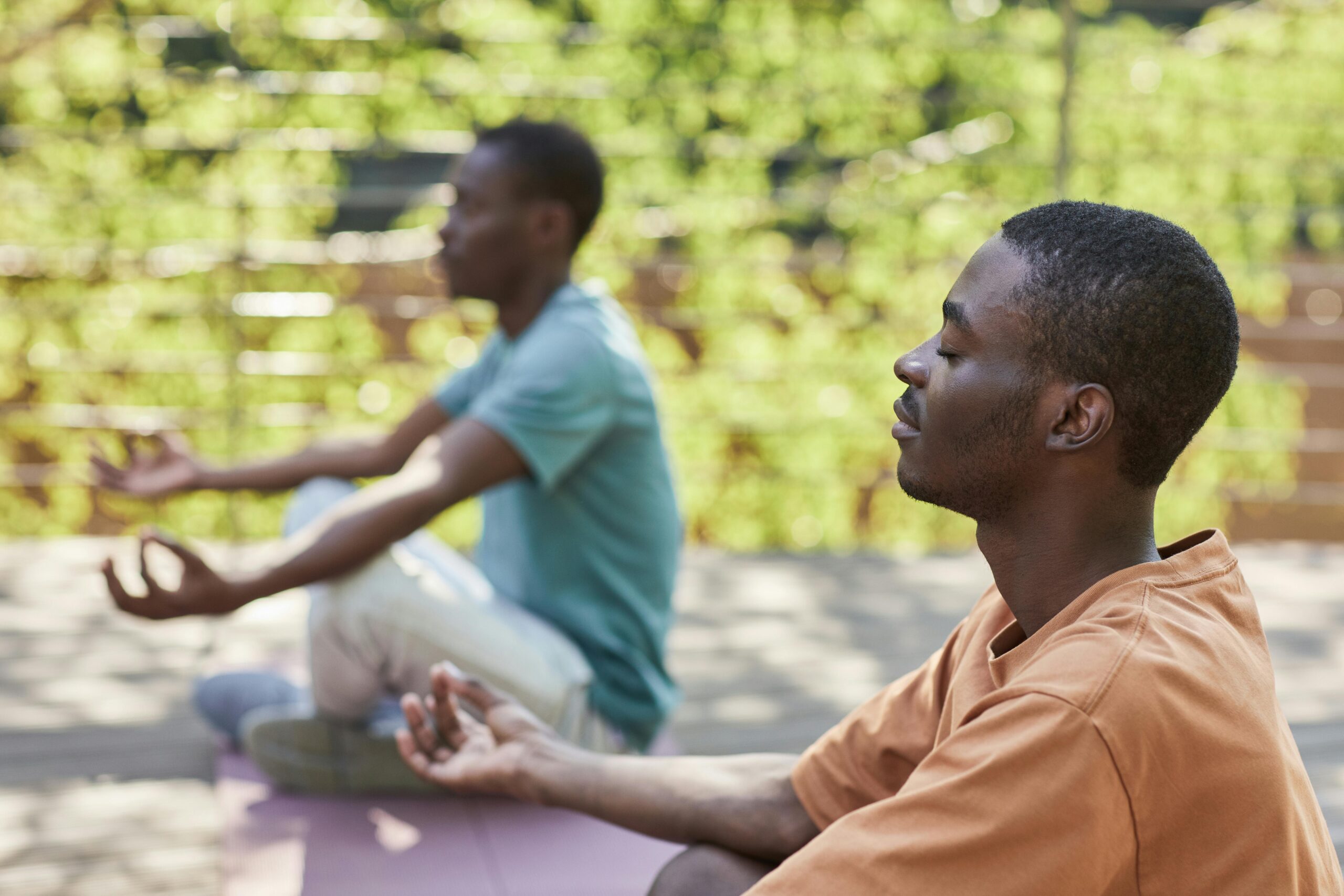
Before attempting the following practices of dharana, kaya sthairyam (physical stability) must first be mastered. You should be able to sit without moving any part of the body for at least half an hour, then you will be ready to begin the practices of dharana. In the initial stage of kaya sthairyam, the body should be comfortable and relaxed in the meditation posture. Later on, as immobility develops, the physical awareness will gradually subside as awareness of stillness increases. At this time the concentration is shifted from the body to the natural breath, so that the mind still has a focus. Ultimately, the awareness of the breath will also subside so that there is only awareness. At that time you are ready to begin dharana(concentration)
Stage 1: Preparation
Sit in a comfortable meditation posture, preferably siddhasana or padmasana. Adjust your position so that you do not have to move any part of the body during the practice. Make sure the spine is erect. Head, neck and shoulders should be slightly back. Place your hands on the knees in chin or jnana mudra. Close your eyes. Become aware of slow deep breathing and count five breaths mentally.
Stage 2: Body posture
Switch your awareness to the body. Concentrate on your meditation posture. Feel your spine rising straight up from the floor, supporting the head. Be aware of the synchronized and balanced position of the arms and legs. Total awareness of the body.
Stage 3: Visualization of body
Visualize your body externally as if you were seeing it in a full length mirror. See your body in the meditation posture from the front, from the back, from the right side, from the left side, from the top. See your body from all sides at one time.
Stage 4: Body tree
Be aware of your whole body. Feel that you are rooted to the floor. Imagine that your body is growing up from the floor like a tree. Your torso is the trunk, your arms and head are the branches, and your legs are the roots. Your body is rooted to the floor and it will not move.
Stage 5: Sensations in the body
Be aware of any physical sensations: cold, heat, wind, itching, pain, uneasiness, tension, stiffness. Direct your awareness to these feelings. Let them be a focus for your mind. If your mind starts to wander, bring it back to the sensations in the body.
Stage 6: Body parts
Direct your awareness to the head. Be aware of the head and nothing else. Feel any sensation in the head. Visualize the head. Shift your awareness to the neck. Feel any sensations in the neck. Continue to be aware. Following the same process, move your awareness to the shoulders, to the right arm, the left arm, the whole of the back, the chest, the abdomen, the right leg, the left leg, and finally the whole body. Be aware of the whole body together. Intensify your awareness of the body. Do another round maintaining full awareness.
Stage 7: Immobility of the body
Make a resolve that, “I will not move my body throughout the whole practice. My body will not move or shake. I will remain steady and motionless like a statue.” Even if you feel an impulse to move a fmger or toe, to adjust your clothing, or to scratch, try to overcome this urge. When you feel the urge to move you must say to yourself, “No, I will not move any part of my body until the end of the practice.”
Stage 8: Steadiness and stillness
Be aware of your physical body, of your meditation posture and of nothing else. There should be total uninterrupted awareness of the whole body. The body is perfectly steady and motionless. Develop the feeling of steadiness. Be aware of your body and steadiness. Be aware of your body and stillness. Your body is absolutely steady and still. Be aware of steadiness. Be aware of your physical body. There is no movement, no discomfort, only steadiness and stillness.
Stage 9: Psychic rigidity
Feel the steadiness and stillness of the body. Gradually your body will become rigid and stiff like a statue, as though all the muscles have frozen. The body should become so stiff that you are unable to move any part, even ifyou try. Total awareness of the body, of immobility, of psychic rigidity. Feel the locked position of the body. Be aware of the body and of stillness.
Stage 10: Breath awareness
As the body becomes stiff and rigid, you will begin to lose physical awareness. At this time shift your attention to the breath. Become aware of the natural breath, without altering or modifying it in any way. Simply watch the breath as it moves in and out of the body. The breath moves in and out in a rhythmic flow. Follow each movement of the breath with your awareness. At the same time become aware of the body. Let the awareness alternate from breath to body, then from body to breath. As the body becomes stiffer and stiffer, the awareness will automatically shift more and more to the breath. No effort is required. When the body is absolutely still and motionless the breath will become more and more subtle, until it seems that you are hardly breathing at all.
Stage 11: State of concentration
As the breath becomes more and more imperceptible, you will begin to experience the pure awareness which functions through the unfluctuating mind. The breathing is responsible for the movements of the mind and body. When the breath becomes very subtle, the mind becomes one-pointed and still. This is the state in which dharana(concentration) must be practised.
Stage 12: Ending the practice
Get ready to end the practice. Gradually become aware of the physical body, of the meditation posture. Feel the weight of the body against the floor. Be aware of the hands resting on the knees. Be aware of the whole physical body. Be aware of the breathing. Watch the breath as it flows in and out. Take a deep breath in and chant Om three times.
Yoga Nidra
Yoga Nidra is the technique of Psychic Sleep, or the Sleep of Awareness, also known as the Yogi’s Sleep. It is an age-old practice from the Tantras which has been re-discovered and developed for modern people and is now being taught all over the world in many different spiritual and non-spiritual guises. Originally, it was discovered and developed by the Yogis as a way of transcending sleep. A way of gaining the greatest benefits of relaxation during the time allotted for sleep without actually going unconscious or losing awareness.
Preparations
If you are practicing Yoga Nidra at home, choose a place which is clean and quiet and ensure that you will not be disturbed. Take the phone off the hook, close the door, protect against draughts, insects, and wind, close any curtains to exclude bright light, clear a space on the floor so that you will not be touching any furniture. Remove your shoes, loosen tight clothing, remove restrictive jewelry, remove glasses if you wear them. Lie down on the floor on your back and, when using a tape recorder, position the crown of the head towards the voice of the instructor. Cover yourself with a blanket. Close your eyes, then position the body as instructed to do so.
Sankalpa – Resolve
At the beginning of Yoga Nidra, and just before the end, you will be reminded to repeat your Sankalpa – your resolution. The word Sankalpa means “determination.” It is not a wish, or a prayer, or a promise, or an airy-fairy sort of affirmation that you will lose interest in several weeks hence. It is a profound realization of something in your life which you are going to do.For this reason, it is not something that someone else can decide for you. It should be phrased in a very direct, short and positive statement. Not something negative that you wish to give up, but rather something positive that you will do. “I will …………….”.
Rotation of Consciousness
Rotation of conciousness through the different parts of the body is not the practice of concentration, and it does not involve any physical movement.During the practice there are only three requirements to be fulfilled:(i)remain aware(ii)listen to the voice and(iii)move the mind very rapidly according to the instructions.The sequence of body parts has to be automatic,spontaneous and thorough.Some people teach yoga nidra in a very unsystematic way.
Awareness of the breath
From the physical and mental experience of body awareness, next in Yoga Nidra one progresses to yet another more subtle level of experience-that of the elements of breath and Prana.When the body remains perfectly still for some time,there is a definite slowing down of the metabolic rates of breath and heart rate. By lying still and watching the natural processes of breath in Yoga Nidra, greater relaxation of body and mind is achieved, as well as deep understanding of the nature of breath and its ramifications upon the body/mind complex.
Awareness of sensation
In the context of Yoga Nidra, “awareness of alternative sensations” refers to a stage where practitioners are guided to experience sensations in their body that are not necessarily physically present but are imagined or visualized. This practice helps deepen relaxation and cultivates awareness of subtle energy within the body. Here’s how it typically unfolds within the practice: These sensations may include warmth, coolness, lightness, heaviness, tingling, or any other subtle feeling.
Visualization
The last stage of yoga nidra induces mental relaxation.Initially, the purpose of visualization in Yoga Nidra is just to practice psychic visual recall and disposal.One type of visual projection involves the use of archetypes. Simple, single images of symbolic meaning which when presented to the mind in deep relaxation, will trigger the release of psychic tension and realizations of spiritual significance. These may be religious symbols, nature symbols, geometric symbols or others. In essence, psychic symbols all have the same basic function, and that is to trigger direct perception of the object in focus and reveal the true nature of inner experience.
Awareness of chakras in an order
Mooladhar,Swadhisthan,Manipur,Anahat,Vishuddhi,Ajna and Sahasra.
Ending the Practices
The visualization practice is usually fineshed with an image that evokes profound feelings of peace and calmness.This makes the unconscious mind very receptive to positive thoughts and suggestions.Therefore ,the practice of yoga nidra is ends with a resolve.This direct order from the concious is the seed enableling one to radically change one’s attitude,behaviour and destiny.
The practice of yoga nidra is concluded by gradually bringing the mind from the condition of psychic sleep to the wakeing state.
Guided Meditation
Guided meditation is a form of meditation where an individual is led through the process by a guide or instructor, either in person, through a recording, or via an app. The guide provides instructions and imagery to help the practitioner focus their mind, relax their body, and achieve a meditative state. This type of meditation often includes several components:
Breathing Exercises: The guide will often start with instructions on deep and mindful breathing to help calm the mind and body.
Body Scanning: Instructions to progressively relax different parts of the body, releasing tension and promoting physical relaxation.
Visualization: Imagery to help the practitioner imagine a peaceful scene or scenario, aiding in mental relaxation and focus.
Affirmations: Positive statements or mantras that the practitioner repeats to foster a sense of well-being and positivity.
Guided meditation is helpful for beginners who may find it challenging to meditate on their own, as well as for experienced meditators seeking to explore new techniques or achieve specific goals, such as stress reduction, improved focus, or emotional healing.
1. Getting Comfortable:
Begin by finding a quiet place where you won’t be disturbed.
Sit or lie down in a comfortable position. Let your hands rest gently on your knees or by your sides.
2. Breathing:
Take a deep breath in through your nose, filling your lungs completely. Hold it for a moment.
Exhale slowly through your mouth, letting go of any tension. Repeat this a few times, focusing on the rhythm of your breath.
3. Body Scan:
Start by bringing your attention to your feet. Feel them relax and let go of any tension.Gradually move up to your legs, releasing any tightness.
Continue this process, moving slowly up through your body – to your hips, abdomen, chest, back, shoulders, arms, neck, and head.Notice how each part of your body feels, and allow it to relax completely.
4. Visualization:
Imagine a place where you feel completely at peace. It could be a beach, a forest, a mountain, or any place that feels serene to you.
Picture yourself in this place, noticing the sights, sounds, and smells. Feel the calmness and tranquility surrounding you.
5. Affirmations:
Silently repeat to yourself positive affirmations. These could be phrases like:
“I am calm and relaxed.”
“I am at peace with myself.”
“I let go of all stress and tension.”
“I am in harmony with my surroundings.”
6. Returning:
When you’re ready to return from your meditation, start by bringing your awareness back to your breath.
Gradually begin to notice your surroundings. Feel the surface beneath you, hear the sounds around you.
Slowly open your eyes, taking your time to adjust back to the present moment.
7. Reflect:
Take a moment to reflect on how you feel. Notice any changes in your body and mind.
Feel free to use this guided meditation whenever you need a moment of relaxation and calm.
Visualization meditation
Visualization meditation is a practice where individuals use mental imagery to achieve a state of relaxation, clarity, and focus. Here’s how you can practice visualization meditation:
Settle Into a Comfortable Position: Find a quiet and comfortable space where you can sit or lie down without distractions.
Relax Your Body: Close your eyes and take a few deep breaths to relax your body and mind.
Release any tension you may be holding in your muscles.
Choose Your Visualization: Decide on a scene or scenario that brings you a sense of calm, joy, or peace. It could be a serene beach, a lush forest, a peaceful garden, or any place that resonates with you.
Engage Your Senses: Imagine yourself in your chosen place. Use all your senses to fully immerse yourself in the experience. Notice the sights, sounds, smells, textures, and even tastes if applicable.
Explore the Details: Take your time to explore the details of your visualization. Notice the colors, shapes, and movements around you. Feel the warmth of the sun, the gentle breeze on your skin, or the softness of the grass beneath you.
Stay Present: If your mind starts to wander, gently bring your focus back to your visualization. Stay present in the moment and continue to engage your senses.
Embrace the Experience: Allow yourself to fully experience the emotions and sensations that arise during your visualization. Embrace feelings of peace, joy, and gratitude.
End Mindfully: When you’re ready to end your visualization, take a few deep breaths and slowly bring your awareness back to the present moment. Wiggle your fingers and toes, stretch your body, and open your eyes.
Visualization meditation can be a powerful tool for reducing stress, enhancing creativity, improving focus, and manifesting goals. With regular practice, you can develop greater proficiency in using visualization to cultivate positive mental states and achieve your desired outcomes.
Preksha Meditation
Preksha Meditation is a form of meditation developed by Acharya Mahapragya in the mid-20th century, rooted in Jain philosophy and spirituality. The term “Preksha” means “to see” in Sanskrit, and the practice focuses on seeing and perceiving the self through a series of meditative techniques. Here’s an overview of its key aspects:
Core Principles
Perception and Awareness: Preksha Meditation emphasizes heightened awareness and perception. It aims to develop a deep understanding of the body, mind, and emotions.
Internal Purification: The practice is intended to cleanse the mind of negative emotions and thoughts, promoting mental and emotional well-being.
Spiritual Growth: It encourages spiritual development by helping practitioners connect with their inner selves and attain a state of inner peace.
Techniques
Kayotsarga (Relaxation with Self-Awareness): This technique involves relaxing the body while maintaining awareness of oneself. It aims to release physical and mental tension.
Antarvratti (Internal Trip): This involves focusing on different internal organs and systems, promoting awareness and health.
Swas Preksha (Perception of Breath): Concentrating on the natural rhythm of breathing to calm the mind and increase concentration.
Chaitanya Kendra Preksha (Perception of Psychic Centers): Focusing on various psychic centers (chakras) within the body to balance energy and enhance mental clarity.
Lesya Dhyan (Color Meditation): Visualizing different colors to influence and purify the mind and emotions.
Anupreksha (Contemplation): Contemplating specific thoughts or ideas to develop a deeper understanding and insight.
Benefits
Mental Clarity and Focus: Regular practice helps in improving concentration and mental clarity.
Emotional Balance: It aids in managing emotions and reducing stress, anxiety, and depression.
Physical Health: Some techniques promote physical health by increasing body awareness and relaxation.
Spiritual Enlightenment: It fosters spiritual growth and self-realization.
Preksha Meditation can be practiced by individuals of all ages and does not require any specific religious beliefs. It involves sitting in a comfortable position, usually in a quiet place, and following the guided techniques.
Conclusion
Preksha Meditation is a comprehensive approach to meditation that combines mental, physical, and spiritual practices to promote overall well-being. Its emphasis on perception and awareness makes it a unique form of meditation that can be beneficial for personal growth and inner peace.
Mantra meditation
Mantra meditation is a type of meditation that involves the use of a repeated sound, word, or phrase, known as a mantra, to help focus the mind and achieve a state of deep relaxation and heightened awareness. Here’s a detailed overview:
What is a Mantra?
A mantra is a word or phrase that is chanted or repeated silently during meditation. It can be a single syllable, like “Om,” or a longer phrase. The mantra is chosen for its spiritual significance, sound quality, or personal meaning to the practitioner.
Benefits of Mantra Meditation
Enhanced Concentration: Repeating a mantra helps to focus the mind, reducing distractions and improving concentration.
Stress Reduction: The rhythmic repetition can induce a state of relaxation, helping to reduce stress and anxiety.
Emotional Balance: Regular practice can help in achieving emotional stability and resilience.
Spiritual Growth: Many practitioners find that mantra meditation deepens their spiritual practice and fosters a sense of connection to a higher power or universal consciousness.
Improved Health: Meditation in general has been linked to better health outcomes, including lower blood pressure, improved sleep, and enhanced immune function.
How to Practice Mantra Meditation
Choose a Mantra: Select a mantra that resonates with you. Traditional mantras like “Om,” “Om Mani Padme Hum,” or “So Hum” are commonly used. Alternatively, you can choose a word or phrase with personal significance.
Find a Comfortable Position: Sit in a comfortable position with your spine straight. You can sit cross-legged on the floor or in a chair with your feet flat on the ground.
Close Your Eyes: Gently close your eyes to minimize visual distractions.
Begin Repeating the Mantra: Silently or softly chant your chosen mantra. Focus on the sound and rhythm of the mantra.
Maintain a Steady Rhythm: Keep a steady pace in repeating the mantra. If your mind wanders, gently bring your focus back to the mantra.
Duration: Start with a few minutes and gradually increase the duration as you become more comfortable with the practice.
Tips for Effective Practice
Consistency: Practice regularly, ideally at the same time each day.
Comfort: Ensure you are in a quiet and comfortable environment.
Patience: It may take time to experience the full benefits. Be patient with yourself and the process.
Mindfulness: Be aware of your thoughts and feelings during meditation without judgment. Use the mantra to bring your focus back when distractions occur.
Conclusion
Mantra meditation is a powerful tool for mental and emotional well-being. Whether you are seeking spiritual growth, stress relief, or improved concentration, incorporating mantra meditation into your daily routine can provide numerous benefits.
Loving-kindness meditation
Loving-kindness meditation, also known as “Metta” meditation, is a practice that involves focusing on cultivating feelings of love and compassion towards oneself and others. Originating from the Buddhist tradition, it aims to promote emotional well-being, reduce negative emotions, and foster a sense of connection and empathy.
Steps to Practice Loving-kindness Meditation
Find a Comfortable Position: Sit comfortably with your spine straight, either on a chair with your feet flat on the ground or cross-legged on the floor. You can also lie down if sitting is uncomfortable.
Close Your Eyes: Gently close your eyes to minimize distractions.
Start with Yourself: Begin by generating feelings of kindness and love towards yourself. You can silently repeat phrases such as:
“May I be happy.”
“May I be healthy.”
“May I be safe.”
“May I live with ease.”
Loved Ones: Gradually extend these wishes to loved ones. Visualize someone you care about and repeat the phrases:
“May you be happy.”
“May you be healthy.”
“May you be safe.”
“May you live with ease.”
Neutral People: Next, extend the wishes to someone you feel neutral about, such as a coworker or acquaintance.
Difficult People: Extend the wishes to someone with whom you have a difficult relationship. This can help in developing compassion and reducing feelings of anger or resentment.
All Beings: Finally, extend these loving-kindness wishes to all beings everywhere, encompassing all people, animals, and living creatures.
Benefits of Loving-kindness Meditation
Enhanced Emotional Well-being: Regular practice can lead to increased positive emotions and reduced negative emotions such as anger, resentment, and jealousy.
Improved Relationships: Fostering feelings of love and compassion towards others can improve interpersonal relationships and social connections.
Reduced Stress and Anxiety: The practice can promote relaxation and reduce stress and anxiety levels.
Increased Empathy and Compassion: Loving-kindness meditation helps in developing greater empathy and compassion towards others, which can lead to more altruistic behaviors.
Better Self-Compassion: It can improve self-esteem and reduce self-criticism by fostering a more loving and accepting attitude towards oneself.
Tips for Effective Practice
Consistency: Practice regularly, even if for just a few minutes each day.
Patience: It may take time to feel the full effects. Be patient and gentle with yourself during the process.
Mindfulness: Be present and fully engage with the emotions and feelings that arise during the meditation.
Non-judgment: If negative thoughts or resistance arise, acknowledge them without judgment and gently bring your focus back to the phrases.
Conclusion
Loving-kindness meditation is a powerful practice for cultivating positive emotions and enhancing overall well-being. By regularly dedicating time to wish well for yourself and others, you can foster a greater sense of connection, empathy, and compassion in your daily life.
Mahamudra meditation
Mahamudra meditation is a profound practice within the Tibetan Buddhist tradition that focuses on realizing the true nature of mind. It is considered one of the highest meditative practices, aiming to bring direct insight into the nature of reality. The term “Mahamudra” means “Great Seal,” signifying the ultimate nature of all phenomena.
Principles of Mahamudra Meditation
Mahamudra meditation encompasses three main aspects:
View (Drishti): Understanding the true nature of mind and reality.
Meditation (Gom): Practicing techniques to directly experience this nature.
Action (Charya): Integrating the insights gained into daily life.
Steps to Practice Mahamudra Meditation
Preparation:
Find a Quiet Space: Choose a serene environment where you can meditate without distractions.
Relax the Body: Sit comfortably, either in a cross-legged position on the floor or on a chair with your feet flat on the ground. Keep your spine straight.
The Practice:
Settling the Mind:
Calm-Abiding (Shamatha) Practice: Begin with a few minutes of calm-abiding meditation to settle the mind. Focus on the breath, a visual object, or simply the sense of awareness itself. Allow thoughts to come and go without attachment.
Resting in Natural Awareness:
Shift your attention from the object of meditation to the awareness itself. Observe the mind without trying to change or control anything. Simply rest in the natural state of awareness, noticing thoughts, emotions, and sensations as they arise and pass away.
Direct Insight (Vipashyana):
Investigate the nature of thoughts and mind. Ask yourself questions like: “What is the nature of these thoughts?” or “Where do these thoughts come from and where do they go?”
Realize that thoughts are transient and lack inherent existence. This insight helps to recognize the empty and luminous nature of mind.
Non-Dual Awareness:
Move beyond the duality of observer and observed. Experience the unity of awareness and its contents. Recognize that the mind and phenomena are inseparable, like waves in the ocean of consciousness.
Integration:
Gradually extend this meditative awareness into daily activities. Practice maintaining the recognition of the nature of mind during everyday experiences, integrating mindfulness and insight into your actions.
Key Concepts in Mahamudra Meditation
Emptiness (Shunyata): The recognition that all phenomena, including the mind, are empty of inherent existence.
Clarity (Prabhasvara): The luminous and aware quality of the mind.
Non-Duality: The understanding that subject and object, self and other, are not separate but interconnected.
Spontaneous Presence: The natural, uncontrived state of awareness that is always present.
Benefits of Mahamudra Meditation
Profound Insight: Direct experience of the true nature of mind and reality.
Emotional Balance: Reduction in attachment to thoughts and emotions, leading to greater equanimity.
Enhanced Clarity: Improved mental clarity and focus.
Spiritual Awakening: Deepened spiritual understanding and realization.
Integration: Ability to bring mindfulness and insight into everyday life, leading to more harmonious living.
Tips for Effective Practice
Guidance: Seek instruction from a qualified teacher, especially if you are new to Mahamudra meditation.
Patience: Progress can be gradual. Be patient and gentle with yourself.
Regular Practice: Consistency is key. Aim to practice daily, even if for short periods.
Study: Complement your practice with the study of Mahamudra texts and teachings.
Conclusion
Mahamudra meditation is a powerful practice that offers deep insights into the nature of mind and reality. Through regular practice, it can lead to profound personal transformation, greater emotional balance, and a deep sense of spiritual fulfillment.
Ajapa Japa meditation
Ajapa Japa meditation is a powerful and ancient practice that involves the spontaneous repetition of a mantra with the breath. Unlike traditional japa, where the mantra is consciously repeated, Ajapa Japa transitions the practitioner to a state where the mantra repeats itself naturally and effortlessly. This practice is known for its ability to bring deep mental and spiritual benefits, including enhanced concentration, inner peace, and spiritual awakening.
Steps to Practice Ajapa Japa Meditation
Preparation:
Find a Quiet Space: Choose a calm and quiet environment where you can meditate without interruptions.
Comfortable Posture: Sit comfortably with your spine straight. You can sit cross-legged on the floor or on a chair with your feet flat on the ground. Rest your hands on your knees or in your lap.
The Practice:
Settle the Mind:
Close your eyes and take a few deep breaths to relax your body and mind. Allow your breath to flow naturally without trying to control it.
Awareness of Breath:
Focus your attention on the natural flow of your breath. Observe the sensation of the breath as it enters and leaves your nostrils.
Introduce the Mantra:
Choose a simple mantra such as “So Hum” or “Ham-Sa.” These are commonly used in Ajapa Japa meditation.
As you inhale, mentally repeat the syllable “So” (or “Ham”).
As you exhale, mentally repeat the syllable “Hum” (or “Sa”).
Coordinate Breath and Mantra:
Synchronize the repetition of the mantra with the rhythm of your breath. Ensure the mantra flows effortlessly with your inhalation and exhalation. Do not force the breath or the mantra; let it be natural and spontaneous.
Deepening the Practice:
Continue this practice, allowing the mantra to become subtler and more effortless with each breath. Gradually, the mantra will start to repeat itself automatically with the breath, without conscious effort.
Witnessing the Mantra:
Shift from actively repeating the mantra to simply witnessing its automatic repetition. Maintain a state of relaxed awareness, observing the mantra as it flows with your breath.
Duration:
Start with a few minutes and gradually increase the duration as you become more comfortable with the practice. Aim for 20-30 minutes per session.
Closing the Practice:
To end the meditation, gradually bring your awareness back to your surroundings. Take a few deep breaths, gently open your eyes, and sit quietly for a few moments before getting up.
Benefits of Ajapa Japa Meditation
Enhanced Concentration: The synchronization of breath and mantra improves focus and mental clarity.
Inner Peace: The practice calms the mind, reducing stress and anxiety.
Spiritual Growth: Ajapa Japa fosters a deep connection to one’s inner self and can lead to spiritual awakening.
Emotional Balance: Regular practice helps in managing emotions and promotes emotional stability.
Increased Awareness: It cultivates a heightened state of awareness and mindfulness.
Tips for Effective Practice
Consistency: Practice regularly, preferably at the same time each day.
Comfort: Ensure you are in a comfortable posture to avoid physical distractions.
Gentleness: Approach the practice with a gentle attitude, allowing the mantra to become effortless.
Patience: Be patient with yourself, as it may take time for the mantra to become automatic.
Guidance: If possible, seek guidance from an experienced teacher to deepen your practice.
Conclusion
Ajapa Japa meditation is a transformative practice that seamlessly integrates the mantra with the breath, leading to profound mental, emotional, and spiritual benefits. Through regular practice, it can help cultivate a state of inner peace, enhanced concentration, and a deep sense of connection to one’s true self.
Trataka meditation
Trataka meditation is a traditional yogic practice that involves gazing steadily at a single point or object to focus the mind and cultivate concentration. The word “Trataka” is derived from the Sanskrit word “trāṭaka,” which means “to gaze” or “to look steadily.” This meditation technique is commonly practiced in various spiritual traditions, including Yoga and Tantra, and it is known for its ability to enhance mental clarity, improve concentration, and induce a state of deep inner stillness.
Steps to Practice Trataka Meditation
Preparation:
Select a Focal Point:
Choose a suitable object for gazing. Common focal points include a candle flame, a black dot on a wall, a symbol, or an image of a deity. Ensure the object is placed at eye level and approximately 1-2 meters away from you.
Prepare the Space:
Find a quiet and comfortable space where you won’t be disturbed. Dim the lights or create a soft, gentle ambiance conducive to meditation.
The Practice:
Seated Posture:
Sit comfortably in a stable posture, either on the floor or on a chair, with your spine erect and your shoulders relaxed.
Gaze at the Object:
Fix your gaze on the chosen focal point with a soft, unwavering gaze. Keep your eyes open throughout the practice. Initially, allow your eyes to blink naturally, but as you become more accustomed to the practice, try to minimize blinking.
Maintain Stillness:
Keep your body and head as still as possible throughout the meditation. Relax any tension in your facial muscles, jaw, and forehead.
Concentration:
Focus your attention entirely on the object of your gaze. Allow all other thoughts and distractions to fade into the background. If your mind wanders, gently bring your attention back to the object without judgment.
Internalization:
After a period of gazing, close your eyes and visualize the image of the object in your mind’s eye. Maintain this internal visualization for a few moments before gently releasing it.
Repeat:
Open your eyes and resume gazing at the object for another round of Trataka meditation. Practice for a duration that feels comfortable, gradually increasing the time as you become more adept.
Closing the Practice:
Release and Relax:
When you’re ready to conclude the meditation, gently release your gaze from the object. Close your eyes and take a few deep breaths, allowing your body and mind to relax.
Reflect:
Take a moment to reflect on your experience. Notice any changes in your mental state, concentration, or sense of inner stillness.
Gratitude:
Express gratitude for the opportunity to practice Trataka meditation and its benefits.
Benefits of Trataka Meditation
Enhanced Concentration: The practice strengthens focus and improves attention span.
Calmness and Relaxation: Trataka induces a state of deep relaxation and inner stillness.
Mental Clarity: Regular practice sharpens mental clarity and promotes clear thinking.
Stress Reduction: It helps alleviate stress, anxiety, and tension.
Spiritual Growth: Trataka is often used as a preparatory practice for deeper spiritual exploration and meditation.
Tips for Effective Practice
Start Slowly: Begin with short sessions and gradually increase the duration over time.
Be Patient: If your mind wanders, gently bring your focus back to the object without judgment.
Regular Practice: Consistency is key to experiencing the full benefits of Trataka meditation.
Use a Timer: Set a timer to ensure you maintain a consistent practice duration.
Precautions
Eye Strain: If you experience discomfort or strain in your eyes, take a break and blink several times before resuming the practice.
Avoid in Certain Conditions: People with certain eye conditions or mental health issues may need to avoid or modify Trataka meditation. Consult with a healthcare professional if you have concerns.
Conclusion
Trataka meditation is a powerful technique for enhancing concentration, calming the mind, and cultivating inner stillness. By practicing regular gazing at a chosen focal point, one can experience profound mental, emotional, and spiritual benefits, ultimately leading to greater well-being and self-awareness.
Vipassana meditation
Vipassana meditation, also known as insight meditation, is a profound and ancient meditation practice that originated from the Theravada Buddhist tradition. It is based on the teachings of the Buddha and aims to develop insight into the true nature of reality by observing the present moment with mindfulness and non-judgmental awareness. Vipassana meditation is renowned for its transformative effects on the mind and is practiced worldwide in both secular and religious contexts.
Principles of Vipassana Meditation
Mindfulness (Sati): Vipassana meditation emphasizes the cultivation of mindfulness, which involves paying attention to the present moment with openness, curiosity, and non-reactivity.
Insight (Vipassana): Through the practice of mindfulness, meditators develop insight into the impermanent, unsatisfactory, and selfless nature of phenomena, as taught in the Buddhist concept of the Three Characteristics (Anicca, Dukkha, Anatta).
Steps to Practice Vipassana Meditation
Preparation:
Find a Quiet Space: Choose a peaceful environment where you can meditate without distractions.
Comfortable Posture: Sit in a comfortable posture with your spine erect. You can sit cross-legged on a cushion or chair, or kneel on a meditation bench. Alternatively, you can practice lying down if sitting is uncomfortable.
The Practice:
Anchor Point: Choose an anchor for your attention, such as the breath, bodily sensations, or mental phenomena (thoughts, emotions).
Breath Awareness:
Start by bringing your attention to the natural rhythm of your breath. Notice the sensations of the breath as it enters and leaves your body, without trying to control it. Focus on the rising and falling of your abdomen or the sensation of air passing through your nostrils.
Body Scan:
Shift your attention to the sensations in your body, starting from the top of your head and gradually moving down to your toes. Notice any tension, warmth, tingling, or other sensations without judgment.
Noting:
As you observe the present moment, use mental labels or notes to acknowledge the arising of different phenomena. For example, silently note “rising” when you inhale and “falling” when you exhale. If thoughts arise, gently label them as “thinking” before returning to your anchor.
Expanding Awareness:
Expand your awareness to include all aspects of experience, including sounds, emotions, and thoughts. Notice how each arises and passes away without clinging or aversion.
Non-Attachment:
Practice observing phenomena with equanimity, allowing them to arise and pass away without becoming attached or averse to them.
Return to the Present:
Whenever you notice your mind wandering or getting caught up in thoughts, gently guide your attention back to your chosen anchor and continue observing the present moment.
Closure:
After the allotted meditation time, gradually bring your awareness back to your surroundings. Take a moment to reflect on your experience before resuming your daily activities.
Benefits of Vipassana Meditation
Insight into Reality: Develops a deeper understanding of the impermanent, unsatisfactory, and selfless nature of existence.
Emotional Regulation: Enhances emotional awareness and resilience, leading to greater emotional balance and well-being.
Stress Reduction: Reduces stress, anxiety, and reactivity by cultivating mindfulness and non-reactivity.
Increased Concentration: Improves attention and concentration by training the mind to focus on the present moment.
Spiritual Growth: Fosters spiritual development and self-transformation by uncovering profound insights into the nature of the mind and reality.
Tips for Effective Practice
Consistency: Establish a regular meditation routine, aiming to practice daily for a set period of time.
Start Small: Begin with shorter meditation sessions and gradually increase the duration as you become more comfortable.
Patience: Be patient with yourself and the process, recognizing that progress takes time and consistent effort.
Non-Judgment: Practice observing your experiences with acceptance and non-judgment, allowing whatever arises to be as it is.
Guidance: Consider attending a Vipassana meditation retreat or seeking guidance from an experienced teacher to deepen your practice.
Conclusion
Vipassana meditation is a profound practice that cultivates mindfulness, insight, and wisdom. By observing the present moment with clarity and non-judgmental awareness, practitioners develop deep insights into the nature of reality and the mind, leading to profound personal transformation and spiritual growth. Whether practiced as part of the Buddhist tradition or in a secular context, Vipassana meditation offers numerous benefits for mental, emotional, and spiritual well-being.
Healing meditation
Healing meditation is a practice that focuses on promoting physical, emotional, and spiritual healing. It utilizes various meditation techniques to facilitate the body’s natural healing processes, reduce stress, and promote overall well-being. While healing meditation can complement medical treatment, it is not a substitute for professional medical care. Here’s how you can practice healing meditation:
Steps to Practice Healing Meditation
Preparation:
Set Intentions: Start by setting clear intentions for your meditation practice. Focus on the specific areas of healing you wish to address, whether physical, emotional, or spiritual.
Find a Quiet Space: Choose a calm and quiet environment where you won’t be disturbed. Create a comfortable meditation space with cushions or a chair.
Comfortable Posture: Sit or lie down in a comfortable position. You can sit cross-legged on the floor, on a cushion, or in a chair with your feet flat on the ground. If lying down, ensure your body is supported and relaxed.
The Practice:
Relaxation:
Begin by taking a few deep breaths to relax your body and mind. Allow any tension or stress to melt away with each exhale.
Body Scan:
Bring your awareness to different parts of your body, starting from the top of your head and moving down to your toes. Notice any areas of tension, discomfort, or pain. With each breath, imagine sending relaxation and healing energy to these areas.
Visualization:
Visualize a healing light or energy surrounding you, enveloping you in its warmth and healing power. You can imagine this light taking on a specific color that resonates with you, such as white or golden light. Visualize this healing light penetrating your body, filling every cell with vitality and rejuvenation. See it washing away any blockages or negativity, leaving you feeling cleansed and renewed.
Affirmations:
Repeat positive affirmations or healing mantras silently or aloud. Affirmations can be tailored to address specific areas of healing, such as “I am healthy and vibrant” or “I am filled with love and compassion.” Allow these affirmations to sink into your subconscious mind, reinforcing your intentions for healing and well-being.
Breath Awareness:
Bring your attention to your breath, observing its natural rhythm without trying to control it. With each inhale, imagine drawing in healing energy and vitality. With each exhale, release any negativity or tension from your body and mind.
Gratitude:
Cultivate a sense of gratitude for your body’s innate healing abilities and for the opportunity to engage in this practice of self-care and healing.
Closing the Practice:
Grounding:
When you’re ready to conclude the meditation, take a few deep breaths and gradually bring your awareness back to your surroundings. Wiggle your fingers and toes, gently stretch your body, and take a moment to reconnect with the present moment.
Reflection:
Reflect on your experience during the meditation. Notice any shifts or changes in how you feel physically, emotionally, or spiritually.
Integration:
Carry the feelings of healing and well-being with you as you go about your day. Practice self-care and continue to nurture yourself in whatever ways feel supportive.
Benefits of Healing Meditation
Stress Reduction: Promotes relaxation and reduces stress, which can have a positive impact on overall health and well-being.
Emotional Healing: Supports emotional healing and helps process difficult emotions such as grief, anxiety, or trauma.
Physical Healing: Enhances the body’s natural healing processes and can alleviate physical symptoms such as pain or tension.
Spiritual Connection: Deepens one’s connection to inner wisdom, intuition, and spiritual guidance.
Self-Compassion: Cultivates a sense of self-compassion and self-love, fostering a nurturing and supportive relationship with oneself.
Tips for Effective Practice
Consistency: Practice healing meditation regularly, ideally daily or as often as needed.
Listen to Your Body: Pay attention to your body’s cues and adjust your practice as needed to suit your unique needs and preferences.
Seek Guidance: Consider seeking guidance from a meditation teacher, therapist, or healer who specializes in healing meditation techniques.
Combine with Other Modalities: Explore combining healing meditation with other healing modalities such as energy work, yoga, or mindfulness practices for enhanced benefits.
Conclusion
Healing meditation is a powerful practice that can support physical, emotional, and spiritual healing. By cultivating mindfulness, visualization, affirmations, and breath awareness, individuals can tap into their body’s natural healing abilities and promote overall well-being. Whether practiced as a standalone meditation or in combination with other healing modalities, healing meditation offers profound benefits for those seeking to restore balance and vitality to their lives.
Chakra meditation
Chakra meditation is a practice that focuses on activating, balancing, and aligning the body’s energy centers, known as chakras. Here’s a step-by-step guide on how to do chakra meditation:
Preparation
Set Intentions: Start by setting clear intentions for your meditation practice. Consider what you hope to achieve, whether it’s balancing your energy centers, promoting healing, or deepening your spiritual practice.
Find a Quiet Space: Choose a peaceful environment where you won’t be disturbed. Create a comfortable meditation space with cushions or a chair.
Comfortable Posture: Sit or lie down in a comfortable position. You can sit cross-legged on the floor, on a cushion, or in a chair with your feet flat on the ground. If lying down, ensure your body is supported and relaxed.
The Practice
Relaxation:
Take a few deep breaths to center yourself and relax your body and mind. Allow any tension or stress to melt away with each exhale.
Chakra Visualization:
Begin by focusing your attention on the first chakra, located at the base of your spine, known as the Root Chakra (Muladhara). Visualize a spinning wheel of vibrant red energy at this location. Imagine this energy center becoming brighter and more balanced with each breath.
Move your attention to the second chakra, located in the pelvic area, known as the Sacral Chakra (Swadhisthana). Visualize a spinning wheel of orange energy and imagine it glowing with vitality and creativity.
Continue this process, moving up through each of the seven main chakras:
Solar Plexus Chakra (Manipura) – Yellow
Heart Chakra (Anahata) – Green or Pink
Throat Chakra (Vishuddha) – Blue
Third Eye Chakra (Ajna) – Indigo
Crown Chakra (Sahasrara) – Violet or White
Spend a few moments on each chakra, visualizing it spinning freely and radiating its associated color and qualities.
Breath Awareness:
As you focus on each chakra, synchronize your breath with the visualization. Inhale deeply as you imagine drawing energy into the chakra, and exhale fully as you release any stagnant or negative energy.
Affirmations:
Repeat positive affirmations or mantras associated with each chakra. For example, for the Root Chakra, you might repeat, “I am grounded and secure,” and for the Heart Chakra, “I am open to love and compassion.” Allow these affirmations to resonate deeply within you, reinforcing the qualities and attributes of each chakra.
Chanting:
Optionally, you can incorporate chanting of bija (seed) mantras associated with each chakra. Examples include “Lam” for the Root Chakra, “Vam” for the Sacral Chakra, “Ram” for the Solar Plexus Chakra, and so on. Chant each bija mantra aloud or silently, feeling its vibrational resonance within the corresponding energy center.
Closing the Practice
Grounding:
When you’re ready to conclude the meditation, take a few deep breaths and gradually bring your awareness back to your surroundings. Visualize roots extending from your body into the earth, grounding you and connecting you to the earth’s supportive energy.
Reflection:
Reflect on your experience during the meditation. Notice any shifts or changes in how you feel physically, emotionally, or spiritually.
Integration:
Carry the feelings of balance, vitality, and connection with you as you go about your day. Practice self-care and continue to nurture yourself in whatever ways feel supportive.
Tips for Effective Practice
Consistency: Practice chakra meditation regularly, ideally daily or as often as needed.
Listen to Your Body: Pay attention to your body’s cues and adjust your practice as needed to suit your unique needs and preferences.
Holistic Approach: Combine chakra meditation with other holistic practices such as yoga, energy work, and mindfulness for enhanced benefits.
Stay Open: Approach the practice with an open mind and heart, allowing yourself to explore and experience the subtle energies of the chakras.
Precautions
Integration: Chakra meditation can sometimes bring up intense emotions or experiences. Ensure you have support systems in place to integrate and process these experiences if they arise.
Seek Guidance: If you’re new to chakra meditation or have specific health concerns, consider seeking guidance from an experienced teacher or practitioner.
Chakra meditation is a powerful practice that promotes balance, healing, and spiritual awakening by working with the body’s energy centers. By incorporating visualization, breath awareness, affirmations, and chanting, practitioners can activate and harmonize the chakras, leading to enhanced vitality, emotional well-being, and spiritual growth.
Devavani Meditation
It is a beautiful meditation to penetrate our subconscious mind & the areas of the brain before we learned the language. It is a very relaxing meditation & can cure insomnia if it is done before going to bed at night. This is not a cathartic meditation. It is a very graceful, subtle mediation. One needs to enjoy this with love, joy & grace. It has a very deep relaxing effect on the body mind. This meditation can be done any time during the day & is supported by the specific audio recording of OSHO Devavani Meditation music.
Osho Devavani Meditation Instructions
Osho Devavani Meditation has 4 stages & last for 60 minutes. Below are the two different instructions.
First Stage: 15 Minutes – Eyes Closed
Sitting: In this stage just keep on listening to the music & remain aware of what is happening inside you.
Second Stage: 15 Minutes – Eyes Closed
Sitting: Remain seated & the music will stop, once the music stops intuitively just start making any sound that comes from within. It should not be a structured word of any language that you may know of. Let it be any illogical, nonsensical or funny sound. Let this sound come gracefully without any pressure or force. Do not cry, shout or scream in this stage. Let this sound be gentle & smooth.
Third Stage: 15 Minutes – Eyes Closed
Standing: In this stage continue making sounds as in the 2nd stage & also give your body freedom to sway or move standing at the same place. In sometime you will some energies around you working by itself & a subtle lathian may take over with unplanned movement of your body. Let the movement of the body in synchronicity of the sound you would be producing.
Fourth Stage: 15 Minutes – Eyes Closed
Lying Down: In this stage just lie down & remain aware of whatever is happening inside your body mind.
Mind Sound Resonance Technique (MSRT)
Mind Sound Resonance Technique (MSRT) is one of the yoga-based relaxation techniques that uses mantra to generate resonance, which is used to induce deep relaxation for mind and body. MSRT can be practiced for improving well-being, concentration, willpower, and relaxation.
MSRT Steps
STEP 1 : Opening prayer.
Om Tryambakam Yajamahe Sugandhim Pushtivardhanam
Urvarukamiva Bandhanan Mrityor Mukshiya Maamritat
Meaning: Om. I adore and worship you the three-eyed Lord Shivathe one who is fragrant and has norished all beings.Free me from the bondage of this worldly life free me from the fear of death by making me realize our immortal nature.
STEP 2 :
a)Loud –A/U/M Kara Chant –AUM – 3 Rounds
b) Ahata-anahata of A…U…M… & AUM – 3 Rounds
STEP 3 : Ahata-anahata of Mrityunjaya mantra.
a)Loud – 3 Rounds
b)Ahat Anahat – Rounds
STEP 4 : Anahata of AUM(Mental Repetition) – 9 Rounds
STEP 5 : Ajapajapa of OM to Silence. – 9 Rounds
STEP 6 : Stay in silence.
STEP 7 : Resolve. -9 Rounds
STEP 8 : Closing prayer.
Om Sarve Bhavantu Sukhinah
Sarve Santu Niraamayaah |
Sarve Bhadraanni Pashyantu
Maa Kashcid-Duhkha-Bhaag-Bhavet |
Om Shaantih Shaantih Shaantih ||
Meaning:
May all become happy
May none fall ill |
May all see auspiciousness everywhere
May none ever feel sorrow |
Om Shaantih Shaantih Shaantih ||
MSRT can be practiced for improving well-being, concentration, willpower, and relaxation. The practice of MSRT has demonstrated to improve stress, anxiety, depression, self-esteem, blood pressure, and heart rate in clinical and non-clinical populations.